Experiment Objective and Scope
This experiment aims to observe the bit-level arbitration mechanism — one of the fundamental features of the CAN (Controller Area Network) protocol — on real hardware. When multiple nodes begin transmitting simultaneously on the CAN bus, the node with the lower ID wins by sending a dominant (0) bit; the node with the higher ID detects that its own recessive (1) bit is being read as dominant (0) on the bus and withdraws. This mechanism operates entirely at the hardware level without any central arbitrator.
| Node | ID (hex) | ID (bin) | Role |
|---|---|---|---|
| ESP32 | 0x456 | 100 0101 0110 | Higher ID — loses |
| BBB | 0x123 | 001 0010 0011 | Lower ID — wins |
At the first differing bit (bit10): BBB sends dominant (0), ESP32 sends recessive (1) — BBB wins.
| Parameter | Value |
|---|---|
| CAN speed | 100 kbit/s |
| Bit time | 10 µs |
| Sample point | 75% |
| Sample rate | 2 MHz |
| Trigger | BBB → ESP32 (GPIO15) |
Experimental Setup
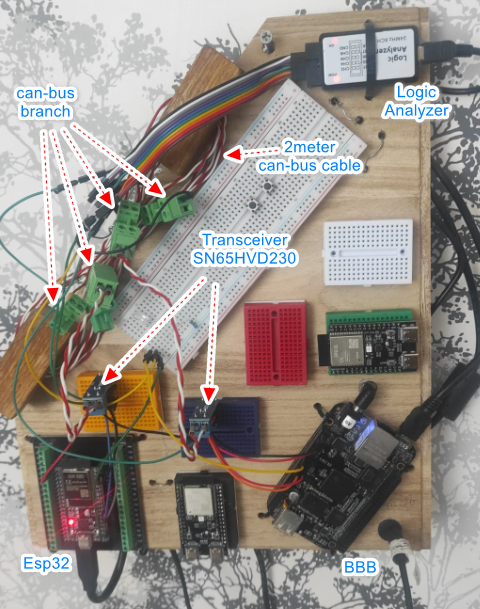
| Component | Model / Spec | Role |
|---|---|---|
| Microcontroller #1 | ESP32 (TWAI driver) | CAN node — ID 0x456, triggered side |
| Microcontroller #2 | BeagleBone Black (SocketCAN) | CAN node — ID 0x123, triggering side |
| Transceiver | SN65HVD230 × 2 | Digital (TTL) ↔ Differential (CAN_H/CAN_L) conversion |
| CAN cable | 2 metres, twisted pair | Physical CAN bus line |
| Termination | 120Ω × 2 (on-board) | Bus impedance: 60Ω |
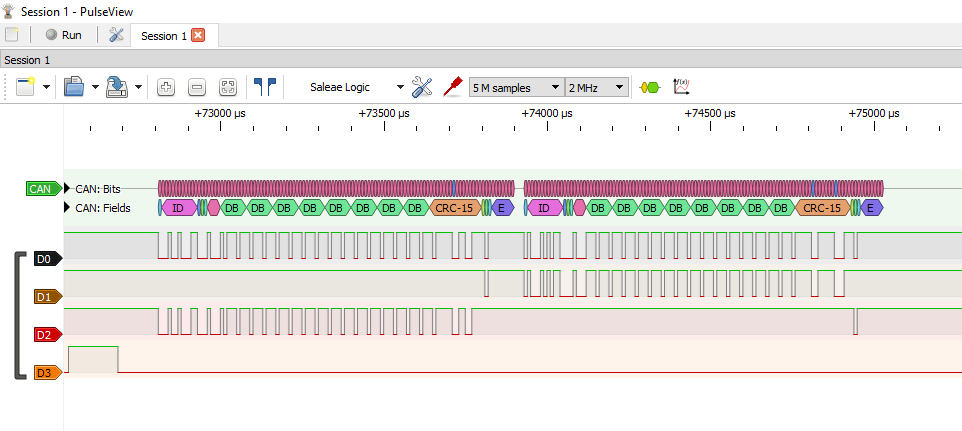
| Logic Analyzer | Saleae Logic 24MHz 8CH | Signal capture and CAN decoding |
Channel Map
Experimental Methodology
The core approach is for BBB to both trigger ESP32 and immediately transmit its own CAN frame. The delay between the two nodes' SOF (Start of Frame) moments is controlled by the software sweepDelay parameter on the ESP32 side.
Trigger
BBB sends a 50µs HIGH pulse from P9.15 to ESP32's GPIO15. A hardware interrupt (ISR) on the ESP32 captures this rising edge.
BBB Frame Transmission
Immediately after the trigger pulse, BBB transmits a frame with ID 0x123 via SocketCAN. Due to kernel network stack latency, this occurs ~250–650µs after the trigger (variable).
ESP32 Frame Transmission
After waiting sweepDelay µs from the ISR trigger, the ESP32 sends a frame with ID 0x456 via the TWAI driver. This delay was swept between 100–170µs.
Arbitration Window
When the two nodes' SOF moments overlap, arbitration occurs. At the first differing ID bit (bit10), BBB sends dominant (0) and ESP32 sends recessive (1) — BBB wins, ESP32 withdraws.
Measurement and Verification
Signals were captured with the logic analyzer; the arb_lost_count (ESP32 TWAI) and arbit-lost (BBB SocketCAN statistics) counters were monitored.
Technical Challenges
Three layered issues were encountered during the experiment, each requiring resolution before the next could be addressed.
ip link show can0 reported UP and ERROR-ACTIVE, yet BBB's TX signal never reached the physical pin.
On Debian 13.5 / Kernel 6.x, P9.19 and P9.20 default to I2C2 mode. The pinmux register value remains 0x30 (GPIO mode, receiver disabled). The system's existing BB-CAN0-00A0.dtbo overlay was added to uEnv.txt as a filename only (no path prefix):
uboot_overlay_addr4=BB-CAN0-00A0.dtbo   # ✓ Correct
uboot_overlay_addr4=/lib/firmware/BB-CAN0-00A0.dtbo # ✗ Wrong (silent failure)On one of the breakout boards, the 100nF bypass capacitor (C1, between VCC and GND) had been accidentally removed during rework. This left the 3.3V supply noisy, causing corrupted differential output. A 10nF capacitor was soldered in place to complete testing.
Both SN65HVD230 breakout boards already had an on-board 120Ω resistor. Adding one more external resistor connected three in parallel:
120Ω ‖ 120Ω = 60Ω        # ✓ Correct (two boards, on-board resistors sufficient)
120Ω ‖ 120Ω ‖ 120Ω = 40Ω # ✗ Wrong (no external resistor should be added)Observations and Measurements

Timing Calibration
Sweep experiments revealed which node transmitted first as a function of sweepDelay:
| sweepDelay Range | Observation | Explanation |
|---|---|---|
< 135 µs | ESP32 (0x456) first | ESP32 faster than BBB, finds bus busy |
~135–140 µs | Target arbitration window | Both nodes start SOF at nearly the same time |
> 140 µs | BBB (0x123) first | BBB starts first, ESP32 finds bus busy |
Internal Latency Measurements (Marker Analysis)
| Node | Marker → Real SOF Latency | Jitter |
|---|---|---|
| ESP32 (TWAI) | ~7 µs (very consistent) | < 2 µs |
| BBB (SocketCAN) | ~73 µs (ortalama) | ±18 µs |
| BBB (Absolute latency) | 250–650 µs | ~400 µs |
Evaluation and Next Steps
Communication established, protocol verified, timing calibration completed. The primary reason bit-level arbitration could not be captured is BBB's structural kernel latency.
Achieved goals:
- 100kbit CAN bus communication established between ESP32 and BBB
- Both nodes correctly read each other's frames (ACK mechanism working)
- CAN frame structure (SOF, ID, DLC, DATA, CRC, ACK, EOF) decoded on the logic analyzer
- Arbitration window (~135–140µs) identified via timing sweep
- Three hardware/software issues identified and resolved (pinmux, capacitor, termination)
Unachieved goal:
arbit-lost counter remained zero across 1000 trigger attempts.
Next Step: Experiment with Two ESP32 Boards
When both nodes use the ESP32's TWAI driver, latency will be ~7µs with <2µs jitter. The symmetric latency between the two nodes will allow software-based entry into the arbitration window, and bit-level collision capture becomes a realistic goal.
| Method | Node Latency | Jitter | Arbitration Probability |
|---|---|---|---|
| ESP32 + BBB (this experiment) | 7µs vs 73µs | ±200µs | Very low |
| ESP32 + ESP32 (next) | 7µs vs 7µs | <2µs | High |